Quick Links to Zahanas activities in Madagascar:
click on any image/issue below



Latest web page additions
- Trees Grow - and the boy who planted it
- Getting ready for the 23/24 school year
- Remembering the dream of a woman
- In Memoriam of Jean (12/23)
- What is the Zahana Cup?
- Seed balls for reforestation
- Vegetable Gardens in 2022
- Celebrating seed balls
- Rice bank revitalized
- Jean Zahana's Master Gardener
- Seed Balls
- Innovative pastry oven
- Bicycles for the road
- Hand cranck sewing machine
- Evaluating Reforestation
- Most innovative cookstove 2020
- Our third gardener
- Bicycles mean mobility
- Back to school is different 2020
- Improved cookstove update
- CEPE once again in 2020
- School closure and COVID-19 Prevention
- Improved cookstoves
- Expaning tree nursery
- Innauguration: second school building
- Moringa trees in the school garden
- Clean and Safe Water in Fiarenana
- Solar cooked moringa noodle soup
- Award of Excellence for CARMMA
- CARMMA and CSB1/CSB2
- First Baby born in the new CARMMA rooms
- Moringa in the school yard
- One man, one tree, 1000 Morings seeds
- Video: Moringa Leaves Omelette
- Planting a Moringa Forest in Madagascar
- Zahana 10th Anniversary
- Raising piglets for breading and income
- Potato a new 'old' idea
- Participatory Development Explained
- A failure story with a happy end
- Awarding reforestation
- Int. Women's Day
- Breadfruit - solar cooked videos
- Solar Cooker Videos
- How to video: Build a school
.png)
.png)
.png)
THE WORK IN AND WITH THE RURAL VILLAGE FIADANANA IN MADAGASCAR
(This longer text from 2005 about the status quo, when Zahana just started working with the Community of Fiadanana. Many of the priorities set by the community, such as building a permanent water supply ,a school has been accomplished since and are documented on this website.)
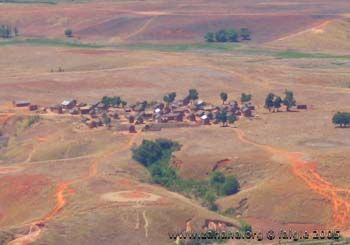 FIADANANA -Some facts:
Fiadanana is located on the the High Plateau of Madagascar, some 230 km West of the capital Antananarivo. Tsiroanomandidy, the next bigger town is about 50 km (30 miles) away. In the Commune of Bevato, Fiadanana in is part the Fokontany of Ambohibary (Fokontany is the smallest administrative unit).
Fiadanana (the word for "peace" in Malagasy) is a typical rural village in the countryside, surrounded by rice fields. With a population of subsistence farmers, their only source of possible income is from growing rice and corn, and raising cattle. About 70% of its 990 inhabitants (as of October 2005) are under 15 years of age.
Fiadanana has no electricity, running water, television or telephone. Nobody in the village owns a motorized vehicle.
Access to schooling in Fiadanana:
The nearest public school is about two km (1.25 miles) from Fiadanana across the stream at Ambohibary. During the 5 to 6 months of the rainy season the stream is impassable and students must walk 15 km (9.3 miles) to cross the stream at the bridge down river.
Health Care in Fiadanana:
next small clinic with a Western trained physician with a Centre de Sante de Base II, (a government run Primary Health Care Center) is in the small town of Bevato. Despite of being a district center, Bevato also has no electricity, running water or telephone, but is accessed time by time by mini-busses. Bevato is a 2-3 hour walk on foot from Fiadanana, or if the dirt road is taken17 km or 10.6 miles away. The next hospital is in Tsiroanomandidy, some 3-4 hours by car from Bevato. A villager requiring a hospital stay must first be carried to Bevato on foot, only there transport by car to the hospital in Tsiroanomandidy can be hired.
WHAT NEEDS TO BE DONE
Zahana is a volunteer grass roots organization based and run by people in Madagascar. To realize these ideas and projects Zahana will require money. This money is not available locally and Zahana therefore has to raise the funds needed internationally. Provided funding can be secured, the project outlined can be implemented starting immediately.
Zahana will work in collaboration with the villagers to realize their development goals. Zahana needs to raise the funds necessary to realize these plans and find or provide the technical expertise required for each project. The villagers will take their affairs in their own hands by contributing their labor and local materials whenever possible. The villagers have been asking the government for water and a school since 1960, right after independence from French colonial rule.
FIADANANA: A PILOT VILLAGE FOR RURAL DEVELOPMENT
I) Access to Clean Water. The villagers identified that most problems they face are linked to the lack of clean water, so they see access to water as their priority. Zahanas focus will be to first get the community a hand pump to temporarily improve the situation. The next step is to provide materials and expertise needed for the villagers to build their own water system so they can pipe water to the village from a source in the mountains. A solar-powered system to provide safe drinking water is part of this strategy.
Learn more about water in Fiadanana: Please click here
To see the new water system built by the villagers in October 2006 click here
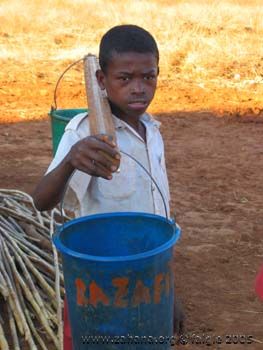
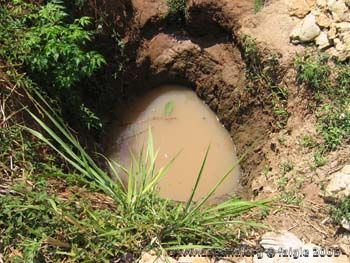
Boy getting water from the source (left). One of the two communal ground water holes in the village (right)
II) Building a School. A school for the villages children was their second priority. This school will be based on the principles of participatory learning and will break out of the mold of traditional didactic education, providing a learning experience that is rooted in the childrens local culture. In addition, the school will be used as a rural university where the older children and adults can learn life skills such as basic health education, improved farming practices and cultivation of traditional medicinal plants and vegetables, can work on environmental improvement projects like reforestation, and can acquire income generating know-how.
Learn more about the future school in Fiadanana: Please click here
Pictures of the bricks being made for the school (August 2006)
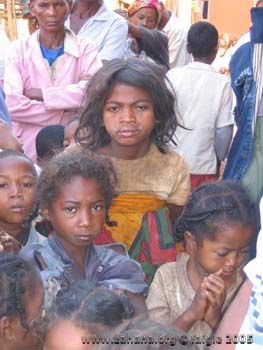
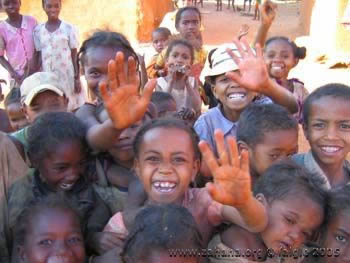
III) Improved Cook Stoves. Villagers are concerned about deforestation. With widespread deforestation it gets increasingly difficult to gather wood and people often have to walk kilometers to find the wood needed for their cooking and building needs.
In Fiadanana the cook stoves currently used burn wood directly. Rethinking cook stoves (including their design and location in the house) is a way for Zahana to address the villagers concern. Improving cook stove technology and efficiency might also prevent indoor smoke related respiratory problems.
Learn more about improving cookstoves in Fiadanana: Please click here
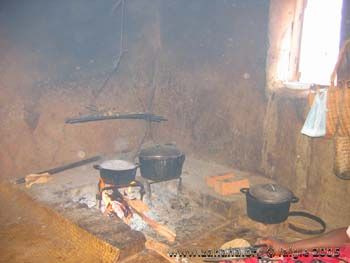
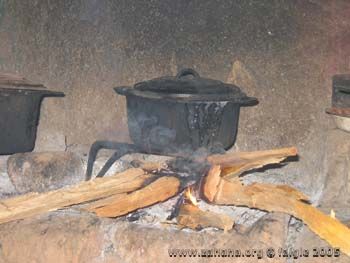
Cook stoves in a kitchen in Fiadanana (left) Cooking rice for lunch over an open fire (right)
IV) A Communal Rice Storage Facility. As subsistence farmers, rice is virtually the only source of potential cash income for farmers. While families have storage capacity in their houses for the rice they eat, they have no way to store extra production and are forced to sell when the price is lowest, right after the harvest. Building a communal rice storage facility has proven to be an effective way to help farmers achieve a better price for their harvest in hundreds of communities across Madagascar. Building such a storage unit is a good example of how with a small investment the financial situation of the farmers can be improved greatly, just by transferring knowledge that has worked elsewhere in the country.
Learn more about rice storage: Please click here
V) Micro Credit or Community Lending Systems. It is Zahana’s goal to create a community based lending system in and for Fiadanana. In many communities where people live from subsistence agriculture, the lack of access to cash for emergencies or purchasing goods or seeds is a major obstacle for improving quality of life or overcoming poverty. Making cash available to the community members at reasonable rates is a vital step to addressing this common problem.
Learn more about the Microcredit: Please click here
VI) Health Care Center. Fiadanana is in the fortunate position to have a renowned and respected traditional healer (known as a traditional practitioner in Madagascar) in its community. Building and establishing a health care center, where the traditional practitioner and a Western trained paramedic can work in synchronicity is envisioned for the future, when funding becomes available. Practicing traditional medicine in such a setting is the best way to preserve invaluable traditional knowledge. The current efforts of the government of Madagascar to formally recognize the cultural importance and medical competence of traditional practitioners for the delivery of affordable healthcare is encouraging, and makes such a health facility a logical addition to a comprehensive development approach.
VII & VIII) Fattening Cattle and Combating Alcoholism. Fattening of cattle, which has great significance for Malagasy culture and rituals, and addressing alcoholism were the other priorities identified by the villagers.