Quick Links to Zahanas activities in Madagascar:
click on any image/issue below




Fiarenana in Madagascar - Our second community development village
Community Development Priorities - Set by the community
Based on the ties established with the community of Fiarenana in October 2008 a formal meeting was held in February 2009.
Latest web page additions
- Trees Grow - and the boy who planted it
- Getting ready for the 23/24 school year
- Remembering the dream of a woman
- In Memoriam of Jean (12/23)
- What is the Zahana Cup?
- Seed balls for reforestation
- Vegetable Gardens in 2022
- Celebrating seed balls
- Rice bank revitalized
- Jean Zahana's Master Gardener
- Seed Balls
- Innovative pastry oven
- Bicycles for the road
- Hand cranck sewing machine
- Evaluating Reforestation
- Most innovative cookstove 2020
- Our third gardener
- Bicycles mean mobility
- Back to school is different 2020
- Improved cookstove update
- CEPE once again in 2020
- School closure and COVID-19 Prevention
- Improved cookstoves
- Expaning tree nursery
- Innauguration: second school building
- Moringa trees in the school garden
- Clean and Safe Water in Fiarenana
- Solar cooked moringa noodle soup
- Award of Excellence for CARMMA
- CARMMA and CSB1/CSB2
- First Baby born in the new CARMMA rooms
- Moringa in the school yard
- One man, one tree, 1000 Morings seeds
- Video: Moringa Leaves Omelette
- Planting a Moringa Forest in Madagascar
- Zahana 10th Anniversary
- Raising piglets for breading and income
- Potato a new 'old' idea
- Participatory Development Explained
- A failure story with a happy end
- Awarding reforestation
- Int. Women's Day
- Breadfruit - solar cooked videos
- Solar Cooker Videos
- How to video: Build a school
.png)
.png)
.png)
More School Links
- Moringa in the school garden
- Highschool exam passed
- Ready for high school entrance exam
- School lunch
- Santa visits the school
- Successful in Secondary School
- Solar Box cookers in the schools
- Watch our How to build a school video
- Getting ready for secondary school
- Celebrating the CEPE diploma (back in 2011)
- Creating a beautiful environment
- The first school in Fiadanana (2006)
- The school in the second village (2009)
- School gardens
- Soup in the School of Fiarenana
- Training the teachers on site
Building our schools:
- Building a second school (2009)
- Inaugurating the community built school (Mar 2010)
- Photos of the almost finished school (Jan. 2010)
- The Community is building their school (Sept 2009)
Building the first school (2006)
- The first school in Fiadanana (2006)
- Photos of Fiadananas new school being built (2005/6)
- Making bricks to build the school
- Analysis of the need for a school (2005)
A community school for all (children) in Fiarenana
- Slide show of the celebrations opening the new school in March 2010
- Inaugurating the community built school in Fiarenana
- The need for the community to build their school for Fiarenana
- The
Community is building their school (photos from Sept. 2009)
- Participatory Development:rebuilding
the old well
- To read the April 09 progress report please click here
- To read the June 09 progress report please click here
- To read the July 2009 progress report please click here
To demonstrate their willingness to collaborate with Zahana they have already made 13,000 bricks for a future school building in the fall of 2008. In contrast to many other villages over 80% of the parents had attended school as children themselves, can all read and write, and see the value and need for education for their children. The community envisions a school building that could become a leaning center for agriculture, health education and rural improvement that would function more as a rural university than a grade school in the traditional sense.
• A background file about the school in Faidanana PDF file (2MB)
Decisions made at the February 2009 meeting:
 Drinking
water
Drinking
water
As
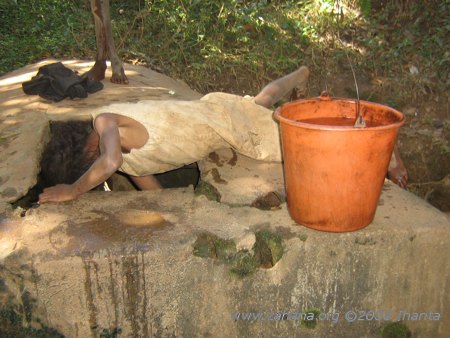
with most villages, safe drinking water is the biggest need. In this meeting
it was decided to first improve the existing community well (see photos on
the website) by building a permanent, covered structure, using the bricks
that can support the hand pump supplied by Zahana. Since this community well
represents their history and tradition, improving it was decided to be better
then digging a new one. Click
here for pictures of the new water system from April 2009.
Papaya
Each family will plant 7 papaya trees: 2 trees for the familys consumption
and 5 where the fruits can be sold, either as dried fruits or fresh in
the market in nearby Bevato.
SRI in Madagascar
The community requested training in SRI, the System of Rice Intensification. SRI
was developed over two decades ago in Madagascar and can dramatically improve
yields, doubling or even tripling crop yields at times. (see Cornell
University SRI). SRI has been very successful around the globe, but only
works if a community is willing to learn about and adopt new planting techniques.
Increasing coffee production
Coffee is already grown in the village, but also consumed there. This is
a great savings as cash does not leave the community to buy coffee. This
cultivation will be intensified to supply neighboring villages and the
community of Bevato. Traditionally farmers must supply coffee at harvest
time to everybody working in their fields, so then the need for coffee
is great. More see Zahanans seed bank
Staying in touch, or the marvels of modern technology:
Staying in touch with remote village communities can be challenging when Zahana members have to travel for over 5 hours to get there, if the roads are passable and there is no mail service or busses that go there. Fortunately the village of Fiarenana has cell phone coverage.
Zahana bought a cell/mobile phone for the community of Fiarenana. They formed a committee of 4 representatives that are entitled to use it. If they have an issue to discuss with Zahana they send a text message/SMS and Zahana calls them back.
All cell phones in Madagascar only work with pre paid minutes, but incoming calls are free, since the caller pays for the calls. Therefore the cost for the villagers to talk to Zahana is minimal (just for the SMS) and Zahana pays for the minutes of the call on their end. All Zahana needs to do is to recharge the phone with more minutes every few months, so the number does not expire and there is now a direct lifeline to exchange ideas and news with Fiarenana.
But Fiarenana has no electricity. To recharge the cell phones battery they need to walk over and hour to the next small town of Bevato to pay to get it recharged there. This service currently costs 2500 FMG (about 25 US cents) per charge with the use of a generator.
This is the first time that such a fancy high tech device has been available for the villagers.